

About Porto
Porto is the city that gave Portugal its name – from very early on (c. 200 BC), when it was called Portus Cale, later becoming the capital of the Condado Portucalense, from which Portugal was formed.

It is also a city known worldwide for its wine, its bridges and contemporary and ancient architecture, its historic centre, classified as a UNESCO World Heritage Site, the quality of its restaurants and its gastronomy, its leading soccer teams, its main public university: the University of Porto, ranked among the 200 best universities in the world and among the 100 best universities in Europe, as well as the quality of its hospitals.

Porto, together with the neighbouring municipalities of Vila Nova de Gaia and Matosinhos, forms the Atlantic Front of Porto, which is the most urbanized population centre in the Metropolitan Area, located on the coast, bordered to the west by the Atlantic Ocean, with the structural influence of the Douro River estuary, which connects Gaia to Porto. The city is the most important in the highly industrialized coastal area of the Northern Region, where most of the country’s most important economic groups are located, such as Altri, the Amorim Group/Corticeira Amorim, Banco BPI, BIAL, EFACEC, Frulact, Lactogal, Millennium BCP, Porto Editora, Sonae, Unicer and the RAR Group. The Portuguese Business Association is based in Porto.
The Northern Region is the only Portuguese region that exports more than it imports.
Porto’s charming riverside district and vibrant urban fabric offer a rich variety of attractions, from museums and historic churches to excellent bars and restaurants. The city presents a unique blend of contemporary art spaces and centuries-old monuments, where cultural layers intersect and reveal the history, traditions, and identity that make Porto distinctive.

Among its most emblematic landmarks are the Porto Cathedral, the Clérigos Tower, and the Church of São Francisco, alongside internationally renowned cultural institutions such as the Serralves Museum and the Soares dos Reis National Museum. The city also features iconic sites like the Palácio da Bolsa, the world-famous Lello Bookshop, and the immersive World of Discoveries experience.
Just across the river, in Vila Nova de Gaia, the historic Port wine cellars offer a unique insight into one of Portugal’s most celebrated traditions. Equally unmissable is the Ribeira district, a UNESCO World Heritage area along the banks of the Douro River, known for its colourful façades, narrow streets, and architectural heritage. Together, these elements create a city that seamlessly combines history, culture, and contemporary life in a truly captivating setting.
The natural surroundings, the countless monuments and museums and its unique gastronomy make this one of the many must-see cities in Portugal.
More information: https://visitporto.travel/en-GB
Registrations
Registrations are open
Register Now!
Important Dates
Camera-ready Submission Instructions
Camera Ready Due: 15 September 2026
Early Registration: 15 September 2026
Track Papers (Deadline passed!)
Notification of Acceptance: Available on EDAS.
Workshop Papers (Deadline passed!)
Tutorial/Exhibition Proposals Deadline: 15 July 2026
Conference Dates
27 – 30 October 2026
IEEE Smart Cities Contest

Help Us Disseminate
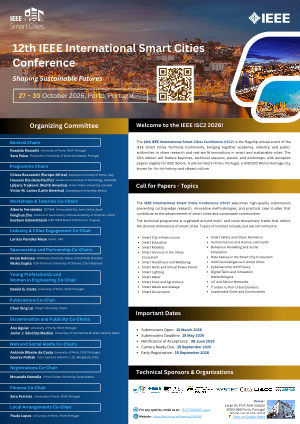
Flyer/Poster — Download flyer/poster (PDF)
Download the flyer as a PDF for printing and paper distribution.
Call for Workshop Papers — Download call for workshop papers (RTF)
Download the RTF version for easy copy‑and‑paste into email messages.