

Panel Discussions
Panel 1: From Sensors to Data: Edge Computing and AI for Next-Generation Smart Cities

Anjali Diwan (Panel Moderator)
Professor of Computer Science
GSFC University, India

Rakesh Kumar
Chair of IEEE Future Directions
Founder & CEO, TCX Inc., San Diego, CA, USA

Georges Zissis
Chair of IEEE Smart Cities
Professor, Laplace Université de Toulouse, France

Anil Roy
President of IEEE Sensors Council
Professor, Plaksha University, India

Nuno Carvalho
Professor and Senior Research Scientist
IT, University of Aveiro, Portugal
Abstract:
The rapid convergence of intelligent sensors, edge computing, and artificial intelligence (AI) is transforming how cities collect, process, analyse, and utilise data to deliver more efficient, secure, sustainable, and resilient urban services. As urban environments become increasingly interconnected and data-driven, the integration of advanced sensing technologies with distributed computing and AI-enabled intelligence offers unprecedented opportunities to improve real-time decision-making, optimise resource management, and enhance the quality of life of citizens. This panel will explore how these emerging technologies can work together to enable the next generation of smart cities, supporting intelligent and adaptive urban infrastructures capable of responding dynamically to evolving operational demands and societal challenges. Bringing together experts from academia, industry, and the IEEE community, the discussion will address key technological developments and practical applications across areas such as intelligent mobility, energy management, environmental monitoring, public safety, and critical infrastructure management. Particular attention will be given to the role of edge computing in enabling low-latency data processing, reducing communication overheads, and supporting distributed AI capabilities closer to where data is generated. The panel will also examine the opportunities and challenges associated with deploying intelligent, interconnected urban systems at scale, including cybersecurity, data privacy, interoperability, scalability, and the reliability of AI-driven decision-making. Furthermore, the discussion will consider the importance of open standards, trustworthy AI, and collaboration between research institutions, technology providers, and public authorities in developing secure, interoperable, and citizen-centric solutions. By highlighting emerging research directions, technological innovations, and opportunities for cross-sector collaboration, the panel aims to identify practical pathways for translating advances in sensing, edge computing, and AI into real-world smart city applications. Ultimately, the discussion seeks to foster knowledge exchange, stimulate innovation, and provide insights into how distributed intelligence and data-driven technologies can accelerate the development of smarter, safer, more sustainable, and resilient urban ecosystems.
Panel 2: Technology Enablement for Smart and Sustainable Campuses: Building Resilient Cities

Surekha Deshmukh (Moderator)
Chair of Smart and Sustainable Campus
IEEE Smart Cities,
Pune, India
Georges Zissis
Chair of IEEE Smart Cities
Professor, Laplace Université de Toulouse, France

Carlos Oliveira
Director of Communication and Cooperation
FEUP, University of Porto, Portugal
Abstract:
University campuses represent microcosms of cities, bringing together complex ecosystems of energy, mobility, digital infrastructure, resource management, and human activity. As such, they offer unique opportunities to develop, test, and demonstrate innovative technologies and sustainable practices that can be replicated and scaled to broader urban environments. This panel will explore how technology-enabled smart and sustainable campuses can serve as living laboratories for innovation, contributing to climate neutrality, resource efficiency, environmental sustainability, and urban resilience. Bringing together experts from academia, industry, and public authorities, the discussion will address key technological and strategic dimensions, including smart digital infrastructure, IoT and AI-driven analytics, renewable energy integration, intelligent mobility, sustainable water and waste management, circular economy practices, and resilient campus operations. Particular attention will be given to the role of emerging technologies in supporting data-driven decision-making, optimising resource utilisation, reducing environmental impacts, and improving the quality of life and well-being of campus communities. The panel will also examine governance models, policy frameworks, and institutional partnerships that enable effective collaboration between universities, municipalities, and industry, fostering innovation, co-creation, and experiential learning. By highlighting successful initiatives, transferable best practices, and opportunities for pilot projects and cross-sector collaboration, the discussion aims to identify practical pathways for translating campus-level innovations into scalable solutions for cities. Furthermore, the panel will consider the importance of inclusiveness, equity, and student engagement in shaping sustainable campus transformations. Ultimately, the discussion seeks to strengthen collaboration among stakeholders, promote knowledge exchange, and demonstrate how smart campuses can act as catalysts for accelerating the transition towards smarter, more sustainable, inclusive, and resilient cities.
Registrations
Registrations are open
Register Now!
Important Dates
Presentations and Posters Submissions
Please see instructions
Upload to EDAS: 22 October 2026
Camera-ready Submission Instructions
Conference Dates
27 – 30 October 2026
Programme Now Live – Explore It!
IEEE Smart Cities Contest

Help Us Disseminate
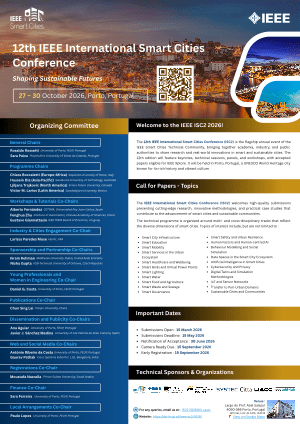
Flyer/Poster — Download flyer/poster (PDF)
Download the flyer as a PDF for printing and paper distribution.
Call for Workshop Papers — Download call for workshop papers (RTF)
Download the RTF version for easy copy‑and‑paste into email messages.