

Workshops
List of workshops and respective co-chairs. Please select the track title (+) to expand for more details on the workshops’s scope and topics of interest.
This workshop focuses on advancing a standardised Impact Assessment Framework for Sustainable Mobility Systems, developed under the IEEE SustainMobility Industry Connections Activity. It addresses the need for globally comparable, measurable, and scalable approaches to evaluate mobility solutions in line with the UN Sustainable Development Goals. The workshop bridges conceptual sustainability strategies and practical implementation, integrating environmental, social, and economic dimensions into a unified assessment approach. It targets researchers, city officials, technology providers, policymakers, industry, and standardisation stakeholders seeking reproducible pathways to deliver climate-aligned, socially inclusive, and continuously verifiable smart mobility systems.
Topics of Interest:
- Impact assessment frameworks for sustainable mobility
- ESG / SDG-based evaluation methodologies
- Taxonomy and terminology for mobility systems
- Sustainable mobility maturity models
- Use cases for urban and regional mobility transformation
- Integration of digital twins, AI, and data analytics
- Standardisation approaches, including IEEE, ISO, and EU alignment
- Policy and regulatory implications
- Mobility infrastructure and energy integration
- Equity, accessibility, and societal aspects of mobility
- Pilot projects and testbed validation concepts
- Certification and conformity assessment for mobility systems
Guided by the motto “Data, Behaviour, and Innovation in Urban Systems”, the workshop focuses on the design and deployment of user-centred mobility services in smart cities. It emphasises the integration of data-driven approaches with human behaviour and urban needs, addressing the gap between system efficiency and user experience, adoption, and inclusivity. The workshop aims to bring together researchers, practitioners, and policymakers to discuss innovative service models, co-creation approaches, real-world implementations, multimodal integration, accessibility, sustainability, and user engagement in shaping inclusive, efficient, and resilient urban mobility ecosystems.
Topics of Interest:
- User-centred design in smart mobility
- Mobility-as-a-Service (MaaS)
- Urban mobility behaviour and travel patterns
- Data-driven mobility services and data spaces
- Multimodal transport integration
- Digital platforms for mobility services
- Accessibility and inclusive mobility
- Sustainable mobility and behavioural change
- AI and analytics for mobility demand prediction
- Co-creation and citizen engagement
- Real-world case studies and pilot projects
- Policy and governance for smart mobility services
Urban Digital Twins are being developed in many cities worldwide, yet the theoretical understanding of what they are envisioned to be and the practical reality of what they are can be very different. This workshop explores UDTs as sociotechnical promises in the making, shaped by sociotechnical imaginaries, institutional arrangements, governance practices, and implicit or explicit value choices. It addresses the gap in UDT literature, which has mainly focused on technical aspects while neglecting the sociotechnical perspectives and challenges that ultimately determine successful implementation. The workshop welcomes researchers, PhD students, experts, and practitioners interested in the status, development, implementation, governance, and sociotechnical challenges of UDTs.
Topics of Interest:
- Case studies of designed and implemented UDTs
- Smart governance of UDTs
- Sustainable and people-centred UDTs
- Value-sensitive design and UDTs
- Sociotechnical challenges faced while designing and implementing UDTs
- Managing sociotechnical challenges of UDTs
- Theoretical and analytical frameworks to explore and study sociotechnical systems and UDTs
This workshop addresses the largely unexplored coupling between thermal comfort conditions and agent-based mobility behaviour in rapidly urbanising coastal environments. It proposes a simulation-driven framework in which AI-accelerated Universal Thermal Climate Index (UTCI) analysis feeds directly into Parallel Transportation System models, enabling experiments that test mobility infrastructure under realistic climate-stress scenarios before development approval. The workshop invites research and practice teams to apply the UTCI-PTS methodology to coastal or climatically stressed cities, using open-access data such as EPW, OpenStreetMap and GTFS. It targets researchers, urban planners, technology providers and practitioners interested in microclimate-mobility coupling, smart city simulation, and governance frameworks for climate-informed development approvals.
Topics of Interest:
- UTCI-informed agent-based pedestrian and mobility modelling
- AI-accelerated microclimate simulation for urban planning workflows
- Parallel Transportation Systems applied to coastal smart cities
- Thermal comfort thresholds and their effect on modal choice behaviour
- Real estate development impact on urban wind and thermal microclimate
- Digital twins coupling building-scale and city-scale simulation
- Seasonal and tourism-driven mobility demand under climate stress
- Data pipelines integrating EPW climate data with transport models
- Governance and regulatory frameworks for climate-informed development approvals
- Post-disaster mobility resilience in coastal urbanised environments
- Open geospatial data infrastructures for thermal-mobility integration
- Thermal justice and equitable access to outdoor comfort in high-density coastal zones
The workshop investigates the role of smart learning and sustainable education as key enablers of future smart cities. It explores how AI, machine learning, IoT, Digital Twins, cloud-edge computing, advanced communication networks, immersive technologies and learning analytics can be integrated into adaptive, secure and sustainable educational ecosystems. It also addresses smart campuses as living laboratories for innovation, sustainability, energy efficiency, digital governance and citizen engagement. The workshop targets researchers, educators, policymakers, smart city planners, government agencies, technology providers, industry practitioners, graduate students and professionals, and welcomes contributions on intelligent, learner-centric and environmentally sustainable education systems.
Topics of Interest:
- Artificial Intelligence, Agentic AI and Generative AI for education
- Intelligent tutoring systems and AI-powered learning assistants
- Learning analytics and educational data mining
- IoT and edge-enabled smart classrooms
- Context-aware and location-aware learning systems
- Virtual Reality, Augmented Reality and Extended Reality in education
- Digital Twin technologies for smart campuses and learning environments
- Metaverse-based education and collaborative learning
- Gamification, interactive learning technologies and personalised learning experiences
- Smart campuses as living laboratories for innovation, sustainability and smart city integration
- Sustainable and green educational infrastructure, energy-efficient campuses and climate-aware learning environments
- Urban innovation ecosystems, knowledge cities and the role of education in smart city development
- Privacy-preserving learning analytics and explainable AI in education
- Cybersecurity, federated learning, trustworthy AI and ethical AI for smart education systems
- Data governance, educational policies and regulatory frameworks for future learning ecosystems
- Education for Sustainable Development Goals, climate change awareness and sustainability education
- Digital inclusion, accessible learning technologies, lifelong learning and workforce reskilling for future economies
- Educational strategies, best practices and governance models for sustainable and resilient learning ecosystems
- Emerging technologies, case studies and real-world applications of smart learning in smart cities
The workshop explores urban digital technology pilots and the critical success factors for upscaling university-born solutions that facilitate the green transition. It focuses on people-empowering technologies that engage users and create behavioural change, while addressing the challenge that many pilots end with the project and struggle to be implemented in other cities and contexts. The workshop aims to identify and systematise key factors to improve upscaling potential, helping policymakers, technology developers and city officials plan and implement urban experiments with greater implementation, exploitation and replicability success.
Topics of Interest:
- Implementation of university-born urban digital technology pilots
- Scaling up people-empowering urban digital technology pilots
- Mobility
- Energy
- Health
- Urban planning
- Water management
- Resilience
- Challenges with upscaling
- Project experience and learnings
- Success cases
- Replication of learnings and experience across cities and contexts
The workshop explores how connected care technologies can be embedded into smart city environments to support early risk prediction, personalised prevention, smart diagnostics, chronic disease management, healthy ageing, assistive living, and healthcare system resilience. It addresses the role of AI, IoT, wearable sensing, mobile health, remote monitoring, digital health platforms, telehealth, smart homes, smart hospitals, and community-based health services in enabling citizens to monitor their wellbeing, receive personalised recommendations, access remote support, and engage with healthcare services before conditions escalate. The workshop targets researchers, clinicians, industry professionals, policymakers, early-career researchers, and students, and welcomes original research papers, applied case studies, technical frameworks, review papers, and work-in-progress papers.
Topics of Interest:
- Preventive digital health in smart cities
- Connected care technologies for healthier and more resilient cities
- Artificial Intelligence and machine learning for preventive healthcare
- IoT, wearable devices, and remote health monitoring
- Mobile health, telehealth, and digital care platforms
- Digital twins for personalised and preventive healthcare
- Smart diagnostics and intelligent clinical decision-support systems
- Early risk prediction for chronic disease prevention
- Obesity, diabetes, cardiovascular health, respiratory health, and lifestyle-related conditions
- Mental wellbeing, stress monitoring, and digital support systems
- Ambient Assisted Living and healthy ageing in smart cities
- Smart homes, smart hospitals, and community-based health monitoring
- Cloud-edge computing and 5G/6G-enabled healthcare systems
- Federated learning and privacy-preserving health analytics
- Explainable AI, trustworthy AI, and human-in-the-loop healthcare systems
- Cybersecurity, privacy, trust, and ethical governance in digital health
- User acceptance, accessibility, and inclusivity in preventive digital health
- Behaviour change technologies and personalised health recommendations
- Virtual Reality, Augmented Reality, and immersive technologies for healthcare, rehabilitation, and wellbeing
- Data governance, interoperability, and regulatory frameworks for smart healthcare
- Healthcare resilience, demand forecasting, and resource optimisation in smart cities
- Case studies, pilots, and applications of preventive digital health
Cities are responsible for a significant share of global greenhouse gas emissions and are increasingly exposed to climate-related risks, including heatwaves, flooding, droughts, and infrastructure disruptions. Achieving carbon neutrality in urban environments requires coordinated action involving governments, academia, industry, and civil society, supported by scientific evidence, innovative technologies, public policies, and international cooperation. This workshop discusses the scientific, technological, governance, and policy challenges associated with the transition towards carbon-neutral cities, with emphasis on the EU Climate-Neutral and Smart Cities Mission and Brazilian initiatives promoting urban decarbonisation, climate resilience, and sustainable urban development. It targets policymakers, city representatives, researchers, innovation agencies, and funding organisations, fostering knowledge exchange and long-term European–Brazilian cooperation.
Topics of Interest:
- Carbon accounting, monitoring, and urban emissions inventories
- Circular economy and urban waste valorisation
- Climate governance and public policies
- Digital twins for sustainable cities
- International cooperation and innovation ecosystems for carbon-neutral cities
- Low-carbon buildings and construction materials
- Nature-based solutions for carbon neutrality
- Renewable energy systems in urban environments
- Sustainable urban mobility and transport decarbonisation
- Urban climate resilience and adaptation
- Urban decarbonisation strategies and roadmaps
- Urban decarbonisation, air quality, and health co-benefits
This workshop explores how spatial digital twin technologies can transform urban data integration, simulation, and decision support within smart city ecosystems. As cities generate increasingly complex spatial data from IoT sensors, connected infrastructure, and geospatial platforms, there is a growing need for frameworks that translate these data into actionable insights for urban management and service delivery. The workshop aims to bring together researchers, technologists, and practitioners to discuss methodologies for building, validating, and operationalising spatial digital twins. It welcomes contributions on data integration frameworks, 3D city modelling, real-time monitoring, intelligent infrastructure, urban simulation, and AI-enabled decision support systems.
Topics of Interest:
- Spatial digital twin frameworks for smart cities
- Integration of IoT and sensor data into city models
- 3D city modelling and geospatial data infrastructure
- Real-time urban monitoring and analytics
- Data interoperability and standardisation for digital twins
- Geographic information systems for smart cities
- Intelligent infrastructure and connected urban systems
- Machine learning and AI for spatial data analysis and decision support
- Urban simulation and scenario modelling
- Open data platforms and data governance for smart city services
- Privacy, security, and ethical considerations in urban spatial data
- Digital twins for urban resilience and sustainable city development
The workshop explores the integration of Large Language Models and autonomous AI agents into smart city platforms, moving from traditional interoperability towards AI-native urban ecosystems. Organised in collaboration with the Smart Metropolis FIWARE iHub at UFRN and the FIWARE Foundation, it focuses on bridging FIWARE Generic Enablers with emerging paradigms such as the Model Context Protocol to enable AI reasoning based on urban data. The goal is to design ecosystems where AI can act upon digital twin and context data while maintaining a strict boundary between intelligence and operational execution. The workshop targets academia, industry and public sector stakeholders, and welcomes peer-reviewed technical papers, early-stage research, ongoing projects and case studies.
Topics of Interest:
- Architectures of FIWARE-based systems embedding Large Language Models and AI agents.
- Integration of the Model Context Protocol with Context Brokers, such as Orion-LD.
- Governance, guardrails and policy enforcement for trustworthy AI operations in smart cities.
- Separation of AI reasoning from operational execution to ensure safety in cyber-physical urban infrastructures.
- Evolution of NGSI standards to support AI orchestration.
- Real-world implementation patterns, use cases and digital twins leveraging AI-native urban data spaces.
This workshop explores the role of autonomous AI agents in transforming smart cities in Latin America. It examines how Agentic AI, capable of independent reasoning and decision-making, can address regional challenges, from improving urban efficiency through automation to reducing socio-economic gaps. The workshop targets researchers, public-sector actors, private companies, civil associations, non-profit organisations, and smart-city practitioners. Participants will analyse real-world LATAM implementations and share data-driven best practices for deploying agents in complex urban environments. Contributions are welcomed on smart infrastructure, public services, healthcare, education, governance, cybersecurity, legal compliance, citizen oversight, and inclusive urban innovation.
Topics of Interest:
- Automated procurement and private bid optimisation using multi-agent systems to analyse public tenders, predict infrastructure project risks, and build competitive, compliant bids.
- Non-profit auditing and citizen oversight agents to monitor municipal spending, track public works milestones, and audit city service delivery.
- Proactive service discovery and user-profiled agents that anticipate citizen needs and push tailored health, education, and transit resources.
- Edge-AI infrastructure for digital divide reduction, enabling lightweight autonomous agents to run on low-bandwidth networks or legacy hardware.
- Decentralised citizen identity and cyber-resilience to protect citizen privacy and safeguard smart-city networks against adversarial attacks.
- Smart contracts and autonomous legal compliance for AI agents executing public utility contracts and interpreting changing municipal codes.
Embedding intelligence in smart municipalities is a key challenge for the coming decades, as cities strive to become more resilient, inclusive, sustainable and efficient. The workshop explores the rapid technological and regulatory transformations shaping urban environments, including AI at the edge, Cyber-Physical Systems of Systems, and the IoT-edge-cloud continuum. It provides a platform for researchers, technologists, policymakers and urban stakeholders to discuss how intelligence can be embedded responsibly, respecting citizen rights, enhancing trust, and complying with regulatory frameworks such as the EU AI Act, Data Governance Act and Cyber Resilience Act.
Topics of Interest:
- Embedding intelligence in smart municipalities.
- Edge AI.
- IoT-edge-cloud continuum for urban environments.
- Smart Cyber-Physical Systems of Systems.
- Security, privacy and compliance with regulatory frameworks.
- Distributed and pervasive systems for smart cities.
- Trusted data spaces and federated data infrastructures for smart cities.
- Embedded and cyber-physical systems for smart cities, regions and municipalities.
- Industrial systems for smart municipality infrastructures.
- Applications and services in smart municipalities.
- Machine Learning and AI in smart environments.
- Emerging network technologies for smart municipalities.
- Society 5.0.
- Legal and regulatory aspects of smart cities, regions and municipalities.
Artificial Intelligence is rapidly reshaping how modern cities are designed, managed, and experienced. This workshop explores the multifaceted impact of AI across smart city systems, including intelligent mobility, energy optimisation, adaptive governance, public safety, digital public infrastructure, healthcare, and citizen-centred services. It aims to examine emerging AI-driven capabilities, such as agentic AI, predictive analytics, autonomous operations, real-time decision systems, digital twins, and AI-enabled urban data platforms, and their potential to improve urban efficiency, sustainability, resilience, and quality of life. It also addresses challenges such as ethics, privacy, data governance, transparency, bias mitigation, cybersecurity, interoperability, environmental impacts, workforce transformation, and the digital divide.
Topics of Interest:
- AI applications in Smart Cities
- AI for intelligent mobility and transport systems
- AI-enabled energy optimisation and smart grids
- AI for public safety, healthcare, and wellbeing
- AI-supported governance and digital public infrastructure
- Agentic AI and autonomous decision systems for urban environments
- Digital twins, IoT-AI integration, and urban data platforms
- Predictive analytics and real-time decision-making in cities
- Ethical, legal, and regulatory aspects of urban AI
- Privacy, transparency, bias mitigation, and cybersecurity in Smart Cities
- Interoperability, data quality, digital divide, and workforce transformation
- Responsible, scalable, and human-centred AI adoption strategies for city governments and urban
Water Supply Systems are undergoing a profound digital transformation driven by advances in sensing, communications, cyber-physical systems, and artificial intelligence. This workshop aims to bring together researchers, practitioners, utility operators, technology providers, and policymakers to discuss emerging challenges and opportunities in managing next-generation Water Supply Systems. It will focus on modelling and representation of future WSS, communication architectures and cyber-physical representations enabling real-time interaction between physical assets and digital platforms, and AI-driven data processing, machine learning, and federated learning techniques for monitoring, prediction, optimisation, and decision support. The workshop seeks to foster interdisciplinary dialogue and support smarter, more sustainable, and resilient urban water infrastructures.
Topics of Interest:
- Digital twins for Water Supply Systems
- Modelling and representation of future WSS
- Smart water infrastructures and cyber-physical systems
- Communication architectures for water networks
- IoT sensing and monitoring for WSS
- Data integration and interoperability in water systems
- AI and machine learning for water management
- Federated learning for distributed water intelligence
- Predictive maintenance and asset management
- Real-time analytics and decision support systems
- Resilience, sustainability, and climate adaptation in WSS
- Security and privacy in smart water infrastructures
Registrations
Registrations are open
Register Now!
Important Dates
Presentations and Posters Submissions
Please see instructions
Upload to EDAS: 22 October 2026
Camera-ready Submission Instructions
Camera Ready Due: 15 September 2026
Early Registration: 15 September 2026
Track Papers (Deadline passed!)
Notification of Acceptance: Available on EDAS.
Workshop Papers (Deadline passed!)
Tutorial/Exhibition Proposals Deadline: 15 July 2026
Conference Dates
27 – 30 October 2026
IEEE Smart Cities Contest

Help Us Disseminate
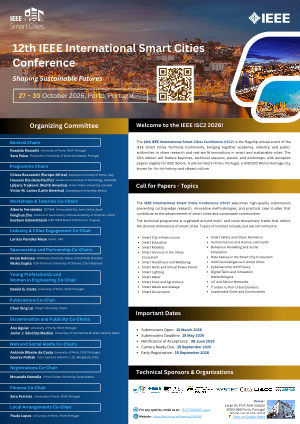
Flyer/Poster — Download flyer/poster (PDF)
Download the flyer as a PDF for printing and paper distribution.
Call for Workshop Papers — Download call for workshop papers (RTF)
Download the RTF version for easy copy‑and‑paste into email messages.