

Thematic Tracks
List of thematic tracks and respective co-chairs. Please select the track title (+) to expand for more details on the track’s scope and topics of interest.
Water systems are a fundamental component of urban sustainability and resilience. Rapid urbanisation, climate change, and increasing pressure on natural resources require smarter approaches to managing water supply, distribution, quality, and reuse. Smart water systems integrate sensing technologies, data analytics, digital twins, and advanced management strategies to improve efficiency, reliability, and environmental performance. This track focuses on innovative methods, technologies, and policies that support the digital transformation of urban water management. Contributions are expected to address both technical and socio-economic aspects of water systems, promoting sustainable and resilient urban water infrastructures.
Topics of Interest:
- Smart water distribution and monitoring
- Urban flood prediction and management
- Water quality monitoring and sensing
- Water reuse and circular water systems
- AI and data analytics for water management
- Digital twins for water infrastructure
- Smart irrigation systems
- Leak detection and infrastructure maintenance
- Integrated urban water management
- Climate resilience in urban water systems
Modern cities depend on reliable, efficient, and sustainable energy systems. Smart grids enable advanced monitoring, control, and optimisation of energy production, distribution, and consumption. Through the integration of digital technologies, renewable energy sources, energy storage systems, and intelligent demand management, smart grids support the transition towards low-carbon urban energy ecosystems. This track focuses on technological and operational innovations that enhance grid resilience, efficiency, and flexibility while enabling citizen participation and energy communities.
Topics of Interest:
- Smart grid architectures and technologies
- Renewable energy integration
- Distributed energy resources
- Energy storage systems
- Demand response and demand-side management
- Energy forecasting and optimisation
- Smart metering and monitoring systems
- Microgrids and local energy communities
- Grid resilience and cybersecurity
- AI and data analytics for energy systems
Effective governance and strategic planning are essential to ensure that smart city initiatives deliver tangible societal benefits and improve citizens’ quality of life. As cities adopt digital technologies and data-driven approaches, new governance models, planning methodologies, and organisational structures are required to guide the digital transformation of urban environments. This track explores multi- and cross-disciplinary perspectives on how policy, leadership, planning, and institutional frameworks can support the successful design, implementation, and management of smart city initiatives. Particular attention is given to the interaction between technology, public policy, investment strategies, and urban development processes. Contributions addressing real-world experiences, lessons learned, and both successful and challenging implementations are especially welcome, helping to inform future strategies for inclusive, sustainable, and well-governed smart cities.
Topics of Interest:
- Smart city policy, legislation, and regulatory frameworks
- Governance models for smart city management and operations
- Smart technology impact, including planned obsolescence and upgrades
- Strategic planning for digital and smart city transitions
- Public leadership and institutional innovation
- Investment strategies, funding models, and public–private partnerships
- Organisational structures for smart city programmes
- Process transformation through digitalisation and smart technologies
- Societal value, quality of life, and public outcomes of smart city initiatives
- Smart education, transformative learning, education for sustainable development
- Smart technologies in urban redevelopment, culture, and heritage preservation
- Lessons learned: case studies, success stories, and implementation challenges
Cities play a crucial role in supporting public health, wellbeing, and quality of life. Smart healthcare solutions leverage digital technologies, urban sensing, and data-driven decision-making to improve healthcare delivery, preventive medicine, and community wellbeing. This track addresses innovations that enhance urban health services, promote healthy lifestyles, and improve accessibility to healthcare through smart technologies and integrated urban systems.
Topics of Interest:
- Digital health technologies
- Telemedicine and remote healthcare services
- Health monitoring through IoT devices
- Urban health analytics and epidemiology
- Smart hospitals and healthcare infrastructures
- Public health surveillance systems
- Age-friendly and inclusive urban services
- Mental health and wellbeing in cities
- AI in healthcare decision support
- Health data governance and privacy
Urban mobility systems are undergoing a profound transformation driven by digital technologies, automation, and sustainability goals. Smart mobility aims to improve accessibility, efficiency, safety, and environmental performance of transport systems through intelligent infrastructure, data-driven planning, and integrated multimodal services. This track explores innovative solutions that support sustainable, connected, and user-centred urban mobility systems.
Topics of Interest:
- Intelligent transportation systems
- Autonomous and connected vehicles
- Multimodal mobility services
- Mobility-as-a-Service (MaaS)
- Urban traffic management and optimisation
- Pedestrian and cyclist safety
- Public transport innovation
- Shared mobility systems
- Transport simulation and modelling
- Sustainable and low-carbon mobility
Urban food systems and surrounding agricultural ecosystems are essential for sustainable cities. Smart agriculture and food systems leverage digital technologies, data analytics, and automation to improve productivity, sustainability, and resilience. This track addresses innovations in urban agriculture, food supply chains, and smart farming technologies that support sustainable food production and distribution within the urban ecosystem.
Topics of Interest:
- Precision agriculture technologies
- Urban and vertical farming
- Smart irrigation and resource management
- Agricultural sensing and monitoring
- AI and robotics in agriculture
- Sustainable food supply chains
- Food waste reduction and circular food systems
- Urban food security strategies
- Climate-resilient agriculture
- Digital platforms for food systems
Urban infrastructures provide the backbone for delivering essential services such as transportation, energy, waste management, safety, and communications. Smart city services integrate digital technologies, IoT systems, and data platforms to improve the efficiency, reliability, and sustainability of these infrastructures. This track focuses on innovative approaches to designing and managing intelligent urban infrastructure systems that enhance service delivery and quality of life.
Topics of Interest:
- Internet of Things for urban infrastructure
- Smart public services
- Intelligent waste management
- Urban sensing and monitoring systems
- Infrastructure digital twins
- Smart buildings and districts
- Urban safety and emergency management
- Integrated urban service platforms
- AI for infrastructure management
- Resilient urban infrastructure systems
Data is a key enabler of smart city innovation. Data spaces allow multiple stakeholders to securely share, access, and use data while preserving sovereignty, privacy, and trust. This track focuses on architectures, governance models, and technologies that support interoperable and trustworthy data ecosystems for cities. Contributions addressing standards, platforms, and data-driven services that facilitate collaboration across urban stakeholders are particularly welcome.
Topics of Interest:
- Urban data platforms and ecosystems
- Data spaces and data sharing frameworks
- Interoperability and data standards
- Data governance and sovereignty
- Privacy-preserving data analytics
- Federated data infrastructures
- Data marketplaces and data economy
- Digital twins supported by data spaces
- Trustworthy AI and data management
- Cross-sector data integration
Sustainability lies at the heart of smart city development. Cities must address climate change, environmental degradation, and social inequalities while supporting economic growth and quality of life. This track explores interdisciplinary approaches that promote environmentally sustainable, socially inclusive, and economically resilient urban environments. Contributions addressing climate adaptation, resource efficiency, and sustainable urban lifestyles are particularly encouraged.
Topics of Interest:
- Climate-neutral urban development
- Urban climate adaptation strategies
- Sustainable urban design and planning
- Circular economy in cities
- Green infrastructure and nature-based solutions
- Urban resilience and disaster preparedness
- Sustainable resource management
- Environmental monitoring systems
- Social inclusion and equitable cities
- Sustainable urban policies
The General Track provides a venue for high-quality contributions addressing topics relevant to smart cities that may not fall directly within the scope of the defined thematic tracks. It welcomes interdisciplinary research, emerging ideas, and innovative applications that advance the theory and practice of smart city development. The track encourages submissions that bridge multiple domains or propose novel perspectives on urban challenges.
Topics of Interest:
- Cross-disciplinary smart city research
- Emerging technologies for urban environments
- Innovative urban applications
- Integrated urban systems
- Urban data analytics
- Smart city architectures
- Socio-technical aspects of smart cities
- Policy and governance perspectives
- Case studies and real-world deployments
- Future visions of smart cities
Registrations
Registrations are open
Register Now!
Important Dates
Presentations and Posters Submissions
Please see instructions
Upload to EDAS: 22 October 2026
Camera-ready Submission Instructions
Camera Ready Due: 15 September 2026
Early Registration: 15 September 2026
Track Papers (Deadline passed!)
Notification of Acceptance: Available on EDAS.
Workshop Papers (Deadline passed!)
Tutorial/Exhibition Proposals Deadline: 15 July 2026
Conference Dates
27 – 30 October 2026
IEEE Smart Cities Contest

Help Us Disseminate
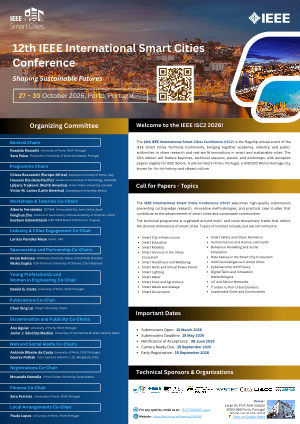
Flyer/Poster — Download flyer/poster (PDF)
Download the flyer as a PDF for printing and paper distribution.
Call for Workshop Papers — Download call for workshop papers (RTF)
Download the RTF version for easy copy‑and‑paste into email messages.