

What is it?
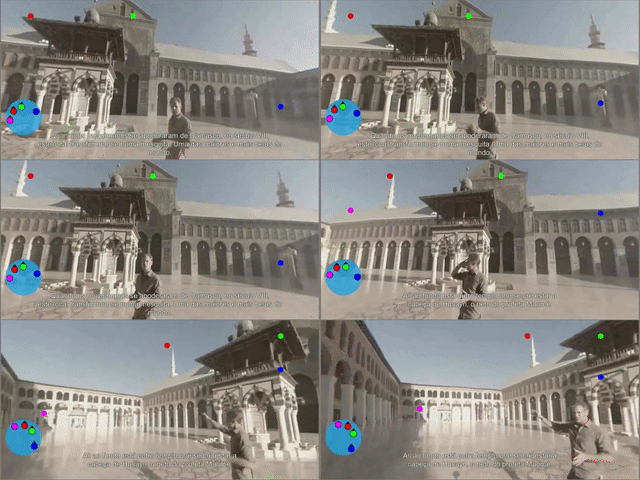
Project supported by Google. This project intends to create an augmented annotation tool for 360º videos. The goal is to bridge the gap between content creators and the technology required to add dynamic annotations to 360º video.
For who?
The main innovation of this tool is the ability of allowing journalists and content producers to create immersive 360º news with dynamic annotations, narrative attention focus points, oriented 3D subtitles and off-the-shelf visual effects. Additionally, the edition will take advantage of a Virtual Reality environment for in-situ annotation and finally the annotated video will be available online through a web player.

How does it Work?
Augmented Video 360 is an editing solution with a visualization layer that will solve problems such as standard annotation and subtitling in VR, the creation of narrative callouts and the visualization of annotated videos in websites. The web visualizer will be able to show callouts for events happening outside the vision scope and present the multimedia annotations, as well as view-independent subtitles.
The project’s scope encompasses two main prototypes. The first a) will an Editor capable of creating annotations in a VR environment. This means that the user will be able to annotate a 360º video using a VR headset with input devices or hand tracking systems. The implemented annotation will be based in the ideas proposed in section 11 of the application form. The main features will be the insertion of a positional annotation in the 360º of the video. These annotations can be static over a certain object, or dynamic, following an object or moving from area to area. The type of annotation will be text, images and hyperlinks.
The second prototype b) will be a Web Visualizer, where the content of the annotated video can be seen in a browser or VR headset but outside the editor, making it useful for the media community.
The annotations should enable rich content creation while adding to the narrative and thus focusing the user in the central theme of the news piece while allowing 360º interactivity. Some of the details of the proposed features were detailed in the application in section 11 and 12 with the impact in digital news journalism being described in section 13.
On the editorial front, the goal is to provide accessible tools for news professionals to have more control and at the same time freedom to edit and add relevant information to 360º videos. Taking this into account, the idea is to test the two prototypes with our media partners.
Contacts:
Rui Rodrigues – rui.p.rodrigues _at_ inesctec.pt
Rui Nóbrega – rui.s.nobrega _at_ inesctec.pt