

Keynote Speakers

Henish Balu
Head of Data & AI
Porto Digital, Portugal
Keynote: From Data to City Decisions: How Porto Builds a Smarter Urban Future
Welcome to Porto. In a city shaped by mobility, tourism, public space, infrastructure, and everyday urban life, data has become a key tool for making better decisions. This talk explores Porto’s urban management platform and how it brings together information from different domains to improve coordination, support action, and strengthen the way the city responds to daily challenges. More than technology alone, this is about turning data into insight and insight into better urban outcomes.
By creating a more connected view of the city through a dynamic platform, Porto is building the capacity to detect patterns, respond with greater agility, and support collaboration across teams and services. It is a practical example of how a city can use a platform approach to move beyond isolated data sources and make data part of everyday urban management and decision-making.
Bio: Henish Balu is Head of Data & AI at Porto Digital, working at the intersection of data, technology, and urban innovation. His work focuses on turning data into operational value through digital platforms, urban intelligence, and decision-support tools. He has experience in the design and implementation of large-scale data pipelines and analytics platforms for smart city applications, with data governance, privacy-preserving data processing, and real-time urban data systems. He has been involved in initiatives related to urban management and data-driven services, helping connect technology with the real challenges of cities.

Chris Mi
Distinguished Professor, Electrical and Computer Engineering
San Diego State University, USA
Keynote: Wireless Power Transfer–Based Solid-State Transformers for Next-Generation AI Data Centers
Abstract: AI data centers are projected to consume hundreds of terawatt-hours annually by 2035, demanding power conversion technologies that are not only energy-efficient but also cost-effective, scalable, and reliable. It is estimated that the global market for power supplies, distribution, and management systems serving AI data centers and cloud computing is expected to reach approximately $145–150 billion. Conventional line-frequency transformers and multi-stage AC-DC architectures suffer from low efficiency, bulkiness, high cost, low reliability, and limited dynamic response. To support the rapid growth of AI workloads and comply with emerging energy and environmental standards, innovative power electronics solutions are urgently needed. This presentation explores the development of a novel megawatt-scale, medium-voltage (MV) power conversion system based on a Variable Air Gap Solid-State Transformer architecture. The approach aims to reduce energy loss, footprint, and cost while enabling flexible, modular deployment, and achieving more reliable operation in large-scale AI data centers.
Bio: Dr. Mi is a Distinguished Professor of Electrical and Computer Engineering at San Diego State University (SDSU), a Fellow of both IEEE and SAE, and the Director of the Cali & Daniel Chang Center for Electric Drive Transportation at SDSU. He was previously a faculty member at the University of Michigan-Dearborn from 2001 to 2015, and an Electrical Engineer with General Electric from 2000 to 2001. He also served as the CTO of 1Power Solutions and EV Safe Charge. Dr. Mi received his Ph. D from the University of Toronto, Canada, in 2001. He is also the Co-Founder and CTO of Novos Power, a company focused on delivering power solutions for modern data centers with the highest efficiency, reliability, and lowest cost.
Dr. Mi was ranked the top 1% of highly cited researchers in the world by Clarivate in 2025, among the top 179 researchers in engineering worldwide to receive that honor. Dr. Mi has published five books and 370 papers. He served as Editor-in-Chief, Area Editor, Guest Editor, and Associate Editor of multiple IEEE Transactions and international journals, as well as the General Chair of over ten IEEE international conferences. Dr. Mi has won numerous awards, including the “Distinguished Teaching Award” and “Distinguished Research Award” from the University of Michigan, IEEE Region 4 “Outstanding Engineer Award,” IEEE Southeastern Michigan Section “Outstanding Professional Award,” and SAE “Environmental Excellence in Transportation (E2T) Award.” He is the recipient of three Best Paper Awards from IEEE Transactions on Power Electronics and the ECCE Student Demonstration Award. In 2019, he received the Inaugural IEEE Power Electronics Emerging Technology Award. In 2022, he received the Albert W. Johnson Research Lectureship and was named the Distinguished Professor, the highest honor given to an SDSU faculty member, and only one award is given each year. In 2023, he received the IEEE PELS Vehicle and Transportation Systems Achievement Award, the IEEE Transactions on Industry Applications Best Paper Award, and the SDSU Innovator of the Year Award. In 2024, he received the prestigious Alumni Distinguished Faculty Award from SDSU. Most recently, he received the Wang Family Excellence Award from the California State University System. In 2026, he received the IEEE Transportation Technologies Award.

Susana Sargento
President of the Scientific Council, Instituto de Telecomunicações
Professor, Electronics, Telecommunications and Informatics
University of Aveiro, Portugal
Keynote: Autonomous mobility in a cooperative and connected environment: from theory to reality
Abstract: Autonomous mobility is entering a new phase in which the central challenge is no longer enabling individual vehicles to navigate autonomously, but enabling large numbers of autonomous vehicles and infrastructure to cooperate in a highly dynamic and uncertain transportation environment. However, current approaches often treat mobility, communication, sensing, and decision-making as largely independent functions, limiting their ability to respond collectively to rapidly changing conditions.
This motivates a shift toward a holistic and cooperative paradigm for autonomous mobility, in which vehicles and infrastructure can share contextual information, anticipate future system states, and jointly optimize mobility decisions. Such a paradigm raises fundamental scientific questions concerning distributed intelligence, real-time coordination, uncertainty-aware decision-making, communication–control interaction, scalability, and safety. This keynote will show how cooperative perception between vehicles, infrastructure, and even pedestrians and cyclists, can help on building a full cooperative environment and decision-making for connected and autonomous mobility. This will include conceptual and scientific research coupled with real experimentation and use cases with autonomous vehicles. It will also show the critical role of a free technology zone and the key interaction between research and real-life testing.
Bio: Susana Sargento is a Full Professor in the University of Aveiro and a senior researcher in the Instituto de Telecomunicações, where she is leading the Network Architectures and Protocols group. She was a visiting PhD student in Rice University (2000-2001), and a Guest Faculty in Carnegie Mellon University (2008). Susana has been leading and involved in several European projects, CMU and MIT-Portugal projects, and in several PRR agendas on Autonomous Mobility, Space, Two-wheels vehicles, Tourism and different Testbeds. Her main research interests, with more than 500 publications, are in the areas of self-organized networks, Intelligent Transportation Systems, 5G and beyond networks and services, with 2 large-scale communication and sensing platforms, in Porto and Aveiro, with Aveiro TechCity Living Lab. Susana has co-founded a vehicular networking company in 2012, Veniam (www.veniam.com), she is the winner of the 2016 EU Prize for Women Innovators, the winner of Femina 2020 prize in Science, and one of the nominated of Prize ACTIVA Inspiring Women 2021. She was the co-coordinator of the national initiative of digital competences in the research axis INCoDe.2030, belonged to the evaluation committee of the Fundo200M (www.200m.pt), and is one of the Scientific Directors of CMU-Portugal Programme. She regularly acts as an Expert for European Research Programmes. Since June 2024, Susana has been a member of the board of directors of Martifer SA, as an independent member, and since July 2024 she has been appointed as President of the Scientific Council of the Instituto de Telecomunicações.

Surekha Deshmukh
Domain Consultant, IAE Unit, TCS
Pune, India
Keynote: AIDC and its Economic, Socio, Environmental impact on Smart City
Abstract: Artificial intelligence may appear virtual, but its supporting infrastructure is intensely physical, requiring land, electricity, water, cooling, connectivity and resilient urban services. As AI adoption accelerates, AI Data Centers (AIDCs) are emerging as a new class of city infrastructure. The growth can place concentrated pressure on electricity networks, water resources, land, infrastructure affordability and the environment. This talk presents a balanced perspective on how cities can capture the economic and digital value of AIDCs while protecting livability, resilience and resource security. It will explore sustainable site selection based on power availability, water stress, climate risk, fiber connectivity, land suitability, circularity and community value.
The session will also discuss opportunities for technology enablement for grid-aware workload scheduling, demand flexibility, renewable-energy integration, reclaimed-water use, waste-heat recovery and transparent sustainability reporting. The talk will demonstrate how geospatial intelligence, urban digital twins, AI forecasting and multi-resource optimization can help authorities to make techno-economic and environmental supportive decision making. It is the time that cities should move from merely approving megawatts to governing outcomes, creating a “social licence to compute” based on measurable economic, environmental and societal value.
The session will be beneficial for city leaders, smart-city authorities, urban planners, utilities, regulators, water authorities, policymakers, sustainability professionals, AIDC developers, hyperscalers, infrastructure investors, engineering consultants, technology providers, academics and community representatives.
Bio: Dr. Surekha Deshmukh with masters in Power Systems and PhD in Electrical Engineering, has 29 plus years of professional experience in the field of Power and Energy. She contributes as a Domain Consultant at TATA Consultancy Services (TCS), India. She leads consulting engagement in the field of Energy Transition, Decarbonization, Sustainability-driven business transformation for Oil, Gas and Utility Industry with AI powered digital interventions.
Dr Surekha is a senior member of IEEE and currently a Chair of Smart and Sustainable Campus Technical Track-IEEE Smart Cities, Vice Chair of IEEE Technology for a Sustainable Climate Matrix Organization (TSCMO), Vice Chair- IEEE PES IAS Chapter Pune Section. She also supports many responsibilities at IEEE Pune Section, IEEE India Council, R10 MGA, IEEE Standards Association, IEEE Smart Cities.
She is conferred upon with many national as well as international awards and recognition. She contributes to World Federation of Engineering Organization, ISGF, IEEMA. She has 35 plus papers, and book chapters sharing her expertise in AI led Operation, Control and Safety of Smart Grid, Climate Resiliency, Energy Transition, Decarbonization and Sustainability.
Registrations
Registrations are open
Register Now!
Important Dates
Presentations and Posters Submissions
Please see instructions
Upload to EDAS: 22 October 2026
Camera-ready Submission Instructions
Camera Ready Due: 15 September 2026
Early Registration: 15 September 2026
Track Papers (Deadline passed!)
Notification of Acceptance: Available on EDAS.
Workshop Papers (Deadline passed!)
Tutorial/Exhibition Proposals Deadline: 15 July 2026
Conference Dates
27 – 30 October 2026
IEEE Smart Cities Contest

Help Us Disseminate
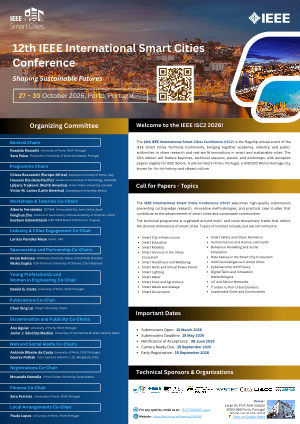
Flyer/Poster — Download flyer/poster (PDF)
Download the flyer as a PDF for printing and paper distribution.
Call for Workshop Papers — Download call for workshop papers (RTF)
Download the RTF version for easy copy‑and‑paste into email messages.