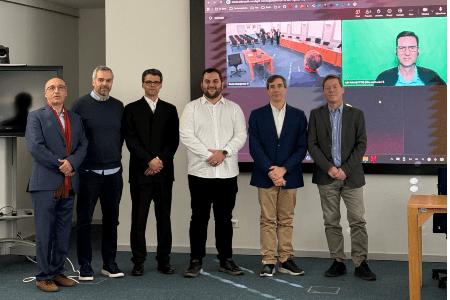
PhD Defense in Digital Media (PDMD): ”Hibridismo Urbano-Digital e Bem-Estar Social: Estratégias para Fortalecer a Conexão Social nas Cidades”

Candidate:
Acilon Himercírio Baptista Cavalcante

Date, Time and Location:
26 January 2026, 14:30, Room Professor Joaquim Sarmento (G129), Department of Civil and Georesources Engineering, Faculdade de Engenharia da Universidade do Porto

President of the Jury:
António Fernando Vasconcelos Cunha Castro Coelho (PhD), Associate Professor with Habilitation, Faculdade de Engenharia da Universidade do Porto

Members:
Isabel Alexandra Reis Gonçalves Ferreira (PhD), Researcher at the Centre for Social Studies, Universidade de Coimbra;
Ivone Marília Carinhas Ferreira (PhD), Assistant Professor, Department of Communication Sciences, Faculdade de Ciências Sociais e Humanas, Universidade Nova de Lisboa;
Ana Isabel Barreto Furtado Franco de Albuquerque Veloso (PhD), Full Professor, Department of Communication and Art, Universidade de Aveiro;
José Manuel Pereira Azevedo (PhD), Full Professor, Department of Communication and Information Sciences, Faculdade de Letras, Universidade do Porto (Supervisor);
Maria Van Zeller de Macedo de Oliveira e Sousa (PhD), Invited Assitant Professor, Department of Informatics Engineering, Faculdade de Engenharia, Universidade do Porto and Researcher at the Instituto de Engenharia de Sistemas e Computadores, Tecnologia e Ciência (INESC TEC).

Abstract:

This thesis investigates the promotion of social well-being in cities through the concept of urban-digital hybridity, which considers social and spatial interactions—whether physical and/or digital—as inseparable in the urban context. Based on an integrative literature review, a set of indicators was identified and categorised to more comprehensively assess the effectiveness of public policies aimed at improving quality of life in technology-mediated urban environments.
The review of indicators combined traditional methodologies—such as those used in the World Happiness Report, published by the United Nations—with metrics related to physical and mental health, community participation, perception of safety, and cultural vitality, while also incorporating emerging variables derived from the use of digital media. The research methodology adapted the mapping and critical analysis of these indicators to Marichela Sepe’s Cartography of Happiness, applying it to contexts of urban-digital hybridity and combining it with empirical digital placemaking experiments.
Case studies and digital placemaking experiences were conducted in the cities of Porto and Póvoa de Varzim, involving local communities, religious institutions, and schools, exploring technological mediation as a catalyst for social bonds and the activation of public spaces. Heatmaps of interactions, together with qualitative field data, allowed the identification of correlations between patterns of urban activation, city morphology, and landscape.
As its main outcome, the research proposes three core metrics for assessing social well-being in hybrid cities: Sense of Belonging, Sense of Place, and Sense of Community, analysed in their urban, digital, and hybrid dimensions.
The thesis’ main contribution is an integrated model for assessing urban social well-being, combining physical and digital metrics to provide an operational framework for urban planning and public policy design, aiming to foster more inclusive, participatory, and well-being-oriented cities.

Inspiring the motivation to learn: Rui Rodrigues honoured with the Teaching Excellence Award on FEUP’s Day 2026

We live in times when the motivation to discover and create seems to be threatened by the ease with which machines offer us information, already organised and interpreted. If machines seem to know everything for us, a central question arises for current teaching: why learn?

It is in this context that the role of the teacher is increasingly being put to the test. And it is precisely to this question that Rui Rodrigues, lecturer in the Department of Informatics Engineering (DEI), affirms that “the intrinsic satisfaction of discovering things, of creating things, of making things happen, of understanding what makes them work, and of sharing this with your fellow human beings” is the most obvious answer.

This educational vision resulted in Rui Rodrigues being distinguished with the Teaching Excellence Award, presented on FEUP’s Day, celebrated on January 13th. For the second consecutive year, a DEI lecturer has been honoured with this recognition, underscoring the sustained quality of the department’s pedagogical practices.

In a context where those who want to learn can often do so independently, Rui Rodrigues argues that the real challenge of teaching is: teaching people to enjoy learning.
“Indifference is all too common among students today, so I interpret this award more as recognition of the various efforts to combat this indifference than as a success in this challenge, which is never won. In this sense, it is an award that is certainly due to many of us (some even more deserving), who continually strive to find new ways to not only get the message across to the recipient, but to have it internalised.”

This approach has had a decisive impact on the careers of many students. Teresa Matos, a PhD student and colleague, recalls that it was in the practical classes in Computer Graphics that she found her area of interest: “It was in Rui’s practical classes in Computer Graphics that I found my area of interest, and it was later in the Student Computer Graphics Centre, with his constant support, that I found my way at FEUP.” She also highlights the professor’s tireless dedication to both students and colleagues, as well as his constant search for pedagogical innovation. “Seeing his tireless dedication day after day encourages me to strive to be a better educator and researcher. I consider him a true example of how to be an excellent professor.

Pedro Silva, a former student and master’s student, also emphasises not only the professor’s scientific rigour, but also his human dimension. Throughout his academic career, he found in Rui Rodrigues a professor who was always available to answer questions and share knowledge, but it was during his dissertation that he recognised a particularly remarkable level of support. “He was a tremendous help during the writing of the document, both for his accurate suggestions regarding its structure and content, as well as for the advice he emphasised throughout the process.” Calmness, humour and empathy are traits that Pedro highlights as fundamental to overcoming the most demanding moments of the academic journey. “There are not many teachers, researchers and human beings like Professor Rui, and I hope he will continue at FEUP for many years to come.

For Rui Rodrigues, teaching remains, above all, a deeply human exercise. In an increasingly automated world, the role of the teacher is to show that learning is not just about accumulating answers, but about developing curiosity, critical thinking and a desire to create — so that students are not only connected to the machine, but also to each other.

This award, granted ex aequo to Prof. Beatriz Oliveira, from the Department of Industrial Engineering and Management (DEGI), recognises not only the individual career of the teacher, but also a way of teaching that values pedagogy as a space for discovery, relationship and construction of meaning.

A. Augusto de Sousa honoured by GPCG – Portuguese Computer Graphics Group

The Portuguese Computer Graphics Group (GPCG), the Portuguese chapter of Eurographics, honoured Professor António Augusto de Sousa, recently retired DEI lecturer, at the International Conference on Graphics and Interaction (ICGI’25), which took place on 13 and 14 November at the Olga Cadaval Cultural Centre in Sintra.

The session was attended by colleagues and former students who wanted to recognise the Professor’s career and exceptional contribution in the areas of Computer Graphics and Human-Computer Interaction, with special emphasis on his involvement as a founding member of the GPCG.

Recognised for his strong commitment to teaching, as well as for his constant support and enthusiasm for multiple academic and student initiatives, Professor António Augusto de Sousa leaves behind a remarkable legacy. This tribute highlighted his role as a reference and the high prestige he continues to enjoy among the Portuguese Computer Graphics and Interaction community.
In the context of this tribute, a brief historical review was requested in which the Professor revisits the founding moment of the GPCG and reflects on the journey and work developed over its 36 years of existence:

“The GPCG – Portuguese Computer Graphics Group was formally registered in 1990, having been established as a National Chapter of the international association EUROGRAPHICS.
In 1998, I was elected to the board of the GPCG, taking on the role of its second president. During this period, I initiated a series of scientific events that are still held annually today, and I promoted, on behalf of the group, the organisation of the EUROGRAPHICS 1998 conference, held in Lisbon.
I sought to create the necessary conditions for the affirmation and dissemination of the GPCG, while also encouraging collaboration with other similar groups, particularly in Spain. This cooperation was the embryo for the later creation of the SIACG conference series – Ibero-American Symposium on Computer Graphics.
Over the years, I have also held various positions in the GPCG’s management bodies, namely Vice-President (2000–2002 and 2013–2014), Treasurer (2014–2016) and Secretary of the General Assembly (2002–2008). In 2015, I led the process of digitising the minutes of all the meetings organised by the group, which were later indexed in the EUROGRAPHICS association’s digital library. More recently, I gathered and organised various historical documents, particularly those relating to the formation of the GPCG, and prepared a summary of the group’s history, which I presented at the EPCGI 2024 conference in Vila Real.

FEUP’S Day 2026 – 189 years of history, people and knowledge

On January 13th, the José Marques dos Santos Auditorium will host the celebrations of FEUP’s Day 2026, with a presentation by the journalist Carla Ascenção and a lecture entitled “Dar ao Pedal” by Jorge Sequeira.

With the motto “A day for everyone, by everyone” the programme includes a wide range of activities open to the internal and external community, with the aim of strengthening the unity of the academic community and celebrating the achievements that consolidate the role of the Faculty of Engineering of the University of Porto as a national and international reference.

The afternoon will once again be dedicated to honouring the members of the community who have stood out the most over the last year. For the second consecutive year, a DEI lecturer has been awarded the Teaching Excellence Award, something that deserves to be highlighted.

The DEI honourees and award winners:

Teaching Excellence Award

Rui Pedro Amaral Rodrigues

Scientific Recognition Award

João Pedro Carvalho Leal Mendes Moreira

Luís Paulo Gonçalves dos Reis

Teaching Recognition Award

Alexandra Sofia Ferreira Mendes

André Monteiro de Oliveira Restivo

António Augusto de Sousa

Gonçalo da Mota Laranjeira Torres Leão

Nuno Filipe Gomes Cardoso

Nuno Honório Rodrigues Flores

Renato Borges Araujo Moura Soeiro

Excellent Performance 

Marisa Isabel Magalhães Brandão Silva

Retired and Emeritus

António Augusto de Sousa

António Miguel Pontes Pimenta Monteiro

DEI Talks | “Great Opportunities for Brazil: Brazilian Microcontroller with RISC-V Architecture and Microelectronics Residency – IC Brazil Innovation Project” by Prof. João Baptista Martins

The talk entitled “Great Opportunities for Brazil: Brazilian Microcontroller with RISC-V Architecture and Microelectronics Residency – IC Brazil Innovation Project” will be presented by Prof. João Baptista Martins on January the 20th, at 14:30, in room B006, moderated by Prof. Rosaldo Rossetti (DEI).

About the Talk:

The objective of this talk is to present the main projects being developed in Brazil in the field of microelectronics. The first deals with the training and development of human resources, called Residency in Microelectronics – IC Brazil Innovation, and the second deals with the design, development, and implementation of hardware and software for a 32-bit microcontroller with RISC-V architecture and BLE (BlueMacaw) communication.

About the Speaker:

João Baptista dos Santos Martins holds a bachelor’s degree (1984) and a master’s degree (1993) in Electrical Engineering from the Federal University of Santa Maria/Brazil. He has a PhD in Computer Science from the Federal University of Rio Grande do Sul/Brazil, specializing in microelectronics (2001). He completed a Post-Doctorate at the Institute of Engineering and Computer Systems, Research in Lisbon (INESCID)/ Portugal (2015). He is the leader of the Microelectronics Group at UFSM and a Full Professor in the Electronics and Computing Department at UFSM. He is Technological Development Researcher (DT) at CNPq. He is General Coordinator of SMDH (Santa Maria Design House) and Coordinator of the Specialization Course in Microelectronics at UFSM. He has experience and publications in the areas of Electrical Engineering and Computing, with an emphasis on
hardware, mainly working on the following topics: microelectronics, FPGA, VHDL, Low Power, Microcontrollers, and Radiation-Tolerant Integrated Circuit Design.

António Oliveira Ferreira Wins Prestigious Prof. Dr. Raul Vidal / Deloitte Award

As part of the Comemoração Novos Mestres 2025, held on November the 22nd at Casa da Música, the Prof. Dr. Raul Vidal/Deloitte Award was presented for the fourth time since its creation in 2022.

The jury awarded the prize to António Oliveira Ferreira, a recent graduate of the Master’s in Informatics and Computing Engineering, who received a cash prize of €3,000.

As part of his Master’s thesis, entitled “Architectural design for the integration of Federated Learning Strategies: the NOUS Project use case,” and supervised by Prof. Ademar Aguiar (DEI), António developed a conceptual software architecture, composed of several interrelated components, which allows human input and supervision to be introduced into Federated Learning systems (decentralised Machine Learning), in order to prevent Artificial Intelligence from making 100% of a system’s decisions.

During his academic career he participated in various social and charitable activities and initiatives, as well as activities organised by JuniFEUP, FEUP’s Junior Enterprise, which enriched his career and contributed positively to the evaluation of his application.

Regarding the recognition, António shares: “It was with great gratitude that I received this award. Once again, many thanks to Deloitte for choosing me, it was an honour.”

He recently joined the Geração Caixa Programme, a trainee programme at Caixa Geral de Depósitos, where he will grow personally and professionally over the course of a year.

*This award is intended to honour a recent graduate from one of the following FEUP courses each year: Master’s in Computer Engineering and Computing (M.EIC) and Master’s in Software Engineering (MESW), who has distinguished themselves in curricular activities, for the quality and innovation of their work in the field of Software Engineering, and for their activities in support of students and of a social and charitable nature.

MECD graduate wins Fraunhofer Portugal Challenge Master’s Thesis Award

Lara Sá Neves, a graduate of the Master in Data Science and Engineering (MECD) from the Department of Informatics Engineering (DEI) at the Faculdade de Engenharia da Universidade do Porto (FEUP), won the first prize in the Master’s Thesis Award category of the 16th edition of the Fraunhofer Portugal Challenge, with the project iHOMER, a pioneering approach in the field of applied artificial intelligence.

Developed as part of her master’s degree, under the supervision of Prof. Carlos Soares (DEI), the work presents an innovative algorithm capable of learning and reorganising information in real time, ensuring explainability and accuracy in dynamic environments.

Currently a doctoral student in the dual programme at Carnegie Mellon University – Instituto Superior Técnico, Lara Sá Neves sees this recognition as proof of the excellence of the education and research carried out at FEUP.

The award ceremony took place on 5 November in the auditorium of Fraunhofer Portugal AICOS, in Porto. In the 2025 edition, the Master Thesis Award category distinguished four projects, with a total prize of €8,000, including work by students from the Universidade de Aveiro and the Instituto Superior Técnico.

Organised since 2010, the Fraunhofer Portugal Challenge annually recognises technological ideas from university students in the areas of Artificial Intelligence, Cyber-Physical Systems and User-Centred Design.

More about the winning projects here.

PhD Defense in Informatics Engineering (ProDEI): ”Novel Computational Methodologies for Detailed Analysis of Human Motion from Image Sequences”

Candidate:
João Ferreira de Carvalho Castro Nunes

Date, Time and Location:
12th December 2025, at 14:00, in Sala de Atos of the Faculdade de Engenharia da Universidade do Porto

President of the Jury:
Pedro Nuno Ferreira da Rosa da Cruz Diniz, Full Professor at the Department of Informatics Engineering of the Faculdade de Engenharia da Universidade do Porto

Members:
Carlos Miguel Fernandes Quental (PhD), Assistant Professor at the Department of Mechanical Engineering, Instituto Superior Técnico, Universidade de Lisboa;
Hugo Pedro Martins Carriço Proença (PhD), Full Professor at the Department of Computer Science, Universidade da Beira Interior;
João Manuel Ribeiro da Silva Tavares (PhD), Full Professor at the Department of Mechanical Engineering, Faculdade de Engenharia, Universidade do Porto (Supervisor);
Luís Paulo Gonçalves dos Reis (PhD), Associate Professor with Habilitation at the Department of Informatics Engineering, Faculdade de Engenharia, Universidade do Porto.

The thesis was co-supervised by Pedro Miguel do Vale Moreira (PhD), Full Professor at the Instituto Politécnico de Viana do Castelo.

Abstract:

Human gait analysis provides critical information on biomechanical function, clinical assessment, and biometric recognition, but achieving accurate and reproducible motion understanding under real-world variability remains a major challenge. Traditional motion capture techniques are dependent on expensive infrastructure and controlled environments, which limit scalability and realworld validity. This thesis addresses these limitations by developing computational methodologies that exploit both RGB and depth information to enable robust, efficient, and fully automatic gait analysis using consumer-grade sensors. The research followed a structured trajectory that encompasses dataset creation, representation design, and methodological innovation. First, an extensive review and comparative analysis of existing vision- and depth-based gait datasets identified gaps in modality diversity, annotation quality, and accessibility. To address these issues, the Gait Recognition Image and Depth Dataset (GRIDDS) was designed, acquired, and publicly released. GRIDDS provides synchronized RGB, depth, silhouette, and 3D skeletal data from 35 participants recorded under controlled conditions, establishing one of the first standardized multi-modal benchmarks for gait analysis and recognition. Building on this foundation, two novel computational gait representations were introduced that fuse two-dimensional appearance cues with three-dimensional skeletal structure to increase robustness to viewpoint, clothing, and carried-object variations. These Gait Skeleton Image (GSI) variants (joint-based and line-based) were integrated within deep learning frameworks and evaluated through extensive experiments, demonstrating competitive and, under certain circumstances, superior performance compared with established appearance-based methods across multiple datasets and covariate conditions. Finally, new methods for gait silhouette interpolation were introduced, combining deterministic geometric reasoning (BRIEF) and bidirectional deep learning (BiSINet) to reconstruct missing frames and enhance temporal coherence. The proposed interpolation techniques significantly improved downstream recognition accuracy and demonstrated strong generalization across datasets and frame-rate conditions. Collectively, the contributions of this work, which span multi-modal data acquisition, robust gait representation learning, and temporal reconstruction, advance the scientific and technological frontiers of human gait analysis, promoting reproducibility, accessibility, and applicability in both clinical and computer vision domains.

DEI Talks | “A Journey Through Cybersecurity: Research on IDPS for NC enabled systems and Real-World Automotive Security Challenges” by Reza ParsaMehr

The talk entitled “A Journey Through Cybersecurity: Research on IDPS for NC enabled systems and Real-World Automotive Security Challenges” will be presented by Dr. Reza ParsaMehr, december the 17th, at 17:00, in room B021.

Abstract:

My journey in cybersecurity began in the classroom. For more than five years, I served as a university lecturer and faculty member in Iran, teaching and supervising students in computer networks, network security, and secure system design. My path then moved into advanced research, where I contributed to the EU Horizon 2020 SECRET project funded under Horizon Europe’s Marie Skłodowska-Curie Actions programme. I developed some intrusion detection and prevention mechanisms for network coding–enabled 5G mobile small cells.
Transitioning to industry introduced a new reality, where cybersecurity directly affects safety, regulation, and large-scale engineering. Today, as Security and Privacy Team Leader at Aumovio Engineering Solution, I work as a security and privacy specialist and oversee blue-team, penetration testing, and cybersecurity maintenance across automotive platforms while ensuring compliance with ISO/SAE 21434, UNECE R155/R156.
In this keynote, I’ll introduce my research on intrusion detection and prevention mechanisms for network-coding–enabled systems, followed by an overview of real automotive cybersecurity challenges and potential solutions.

About the Speaker:

Dr. Reza ParsaMehr is a cybersecurity specialist with a background as a university faculty member, researcher, and industry security leader. He holds a Ph.D. in Security in Telecommunications and currently leads the Security and Privacy Department at Aumovio Engineering Solutions, focusing on automotive cybersecurity, secure architecture design, and regulatory compliance.

Creativity Talks | “Neurorobotics: Connecting the Brain, Body, and Environment” by Jeffrey L. Krichmar

The seventeenth session of Creativity Talks will feature Professor Jeffrey L. Krichmar, an expert in neurorobotics and computational neuroscience at the University of California, Irvine, as the keynote speaker, presenting “Neurorobotics: Connecting the Brain, Body, and Environment.”
The talk will take place on December the 4th 2025, at 17:30, and will be moderated by Armando Sousa (DEEC).

Abstract:

Neurorobots are robots whose control systems follow structural and dynamical aspects of the nervous system. Their artificial brains can be thoroughly probed and recorded as the robot interacts with the world. Neurorobotic design principles fall into three categories that follow natural organisms: First, they must react decisively to sensory events. Second, they must have the ability to adapt, learn and remember over their lifetime. Third, they must weigh the different and sometimes conflicting options that are crucial for completing tasks. Following these principles can not only increase our understanding of how brain responses lead to flexible behavior, but they may also lead to more intelligent systems. In this talk, I will describe the field of neurorobotics and then present neurorobot interaction case studies that focus on how neuromodulation and neurohormones can influence affect, learning, and behavior.

The talk will be broadcast online:

About the Speaker:

Jeffrey L. Krichmar received a B.S. in Computer Science in 1983 from the University of Massachusetts at Amherst, a M.S. in Computer Science from The George Washington University in 1991, and a Ph.D. in Computational Sciences and Informatics from George Mason University in 1997. He spent 15 years as a software engineer on projects ranging from the PATRIOT Missile System at the Raytheon Corporation to Air Traffic Control for the Federal Systems Division of IBM. From 1999 to 2007, he was a Senior Fellow in Theoretical Neurobiology at The Neurosciences Institute. Since 2008, he has been a Professor in the Department of Cognitive Sciences and the Department of Computer Science at the University of California, Irvine. Krichmar has over 20 years of experience designing adaptive algorithms, creating neurobiologically plausible neural networks, and constructing brain-based robots whose behavior is guided by neurobiologically inspired models. He has over 160 publications and holds 9 patents. His work has been funded by the Defense Advanced Research Projects Agency (DARPA), Intelligence Advanced Research Projects Activity (IARPA), National Science Foundation, and the Air Force Office of Scientific Research. Additionally, he has worked with industry on sponsored research contracts from Qualcomm, Northrup Grumman Corporation, and Toyota Motor North America. He is a Senior Member of IEEE and the Society for Neuroscience. He recently published a book, “Neurorobotics: Connecting the Brain, Body, and Environment” that lays out principles for designing intelligent systems.