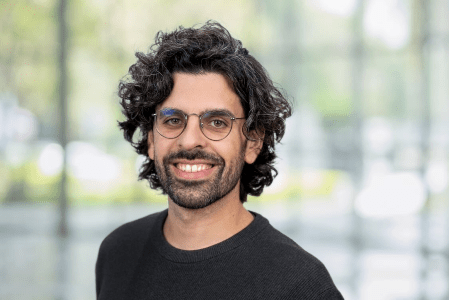
The talk entitled “The impact of link recommendation algorithms on human social dynamics” will be presented by Prof. Fernando Pascoal dos Santos (University of Amsterdam) on March the 20th, at 11:00, in room I-105. The session will be moderated by Prof. Sérgio Nunes (DEI).
About the Talk:
“Online social networks increasingly shape human beliefs and behavior. In these environments, algorithms to personalize contents and provide recommendations are pervasive. Link recommendation algorithms are implemented to recommend new connections to online platforms users, based on supposed familiarity, similar interests, or the potential to serve as a source of useful information. These algorithms influence the evolution of social networks, yet their long-term impacts on human social dynamics remain unclear. In this talk, I will discuss models to study such effects. I will discuss how algorithmic link recommendations interplay with opinion dynamics, and the potential long-term impacts of such algorithms on polarization. I will also discuss methods based on agentic multi-systems, powered by LLMs, to test social media interventions aiming at mitigating polarized dynamics. We will observe that preferentially establishing links with structurally similar nodes (i.e., sharing many neighbors) results in network topologies that are amenable to opinion polarization.”
About the Speaker:
Fernando P. Santos is an Associate Professor at the University of Amsterdam. He is a member of the Socially Intelligent Artificial Systems group, where he leads the Prosocial Dynamics Lab. Fernando’s research lies at the interface of AI and Complex Systems: he is interested in understanding behavioral dynamics in systems of adaptive learning agents and designing (pro)Social AI. Previously, Fernando was a James S. McDonnell Postdoctoral Fellow at Princeton University. He completed his PhD in Computer Science and Engineering at Instituto Superior Técnico with Francisco C. Santos, Jorge M. Pacheco, and Ana Paiva. Fernando is an ELLIS Scholar and member of the board of directors of the International Foundation for Autonomous Agents and Multiagent Systems. He was awarded an ERC Starting Grant to study the impact of link-recommendation algorithms on human behavioural dynamics.