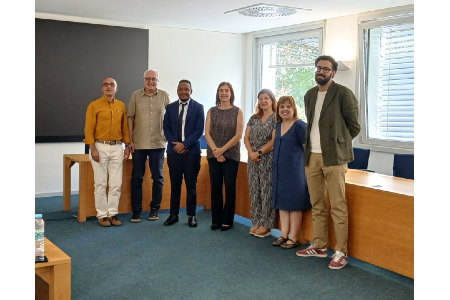
PhD Thesis Defence in Informatics Engineering (ProDEI): ”Generative Approaches for Case-Based Explanations in Medical Image Analysis”

Candidate:
Maria Helena Sampaio de Mendonça Montenegro e Almeida

Date Time and Location:
16 June 2026, 14:30, Sala de Atos, Faculdade de Engenharia da Universidade do Porto

President of the Jury:
Carlos Miguel Ferraz Baquero-Moreno (PhD), Full Professor at the Department of Informatics Engineering of the Faculdade de Engenharia da Universidade do Porto

Members:
Peter Johannes Schüffler (PhD), Professor at the Technical University of Munich, Germany;
Carlos Jorge Andrade Mariz Santiago (PhD), Research Assistant at the Robotics and Engineering Systems Laboratory (LARSyS) and Invited Assistant Professor of the Department of Electrical and Computer Engineering of the Instituto Superior Técnico da Universidade de Lisboa;
Jaime dos Santos Cardoso (PhD), Full Professor of the Department of Electrical and Computer Engineering of the Faculdade de Engenharia da Universidade do Porto (Supervisor);
Luís Filipe Pinto de Almeida Teixeira (PhD), Associate Professor of the Department of Informatics Engineering of the Faculdade de Engenharia da Universidade do Porto.

Abstract:

Artificial Intelligence models have been extensively applied to medical image analysis tasks over the past years, achieving outstanding results. However, the obscure reasoning of the models and the lack of supportive evidence causes both clinicians and patients to distrust their predictions, hindering their adoption in clinical practice. In recent years, the research community has focused on developing explanations capable of revealing a model’s reasoning. Among the various types of explanations, case-based explanations emerged as particularly intuitive for medical practitioners. While these types of explanations have been widely researched, they still possess limitations that compromise their real-world application. The main goal of this thesis is to overcome the limitations of medical case-based explanations, enabling their deployment in clinical practice.

To identify the main weaknesses of case-based explanations, we conduct a literature review on models that provide such explanations in healthcare. Through the analysis of existing works, we verify that the explanations raise privacy concerns by sharing sensitive images of patients, and lack the interactiveness required for clinicians to engage with the explanation. Furthermore, most works do not evaluate nor clinically validate the explanations through user studies with clinicians. Targeting these limitations, we propose deep generative models to obtain privacy-preserving, controllable and interactive explanations to explain the decisions of deep learning models.

To propose a privacy-preserving system for safely sharing case-based explanations, we start by reviewing the literature on image anonymisation techniques and identifying their vulnerabilities. In particular, we identify vulnerabilities by proposing two privacy attacks: a membership inference attack targeting deep generative models that generate synthetic images, and a superimposed image decomposition model to reverse the common anonymisation strategy of image averaging. After outlining the requirements that a privacy-preserving system for medical case-based explanations must fulfil, we propose privacy-preserving models capable of simultaneously anonymising medical images and generating counterfactual explanations. The proposed models rely on disentangled representation learning to separate identity and clinical traits, enabling their individual manipulation. Through this strategy, we can also separate and manipulate causal factors related with the clinical task to obtain controllable counterfactual explanations. To obtain interactive counterfactual explanations, we propose models to manipulate regions of medical images according to a segmentation mask, measuring their impact on a prediction. To evaluate the proposed models, we perform experiments on medical datasets like chest radiographs, verifying the models’ capacity to manipulate medical images for the purposes of generating explanations.

Finally, to show the wide applicability of the proposed models beyond their original purpose of generating case-based explanations, we apply them as decision-support systems in healthcare. More specifically, we adapt the models for predicting the aesthetic outcomes of breast cancer treatment, to facilitate the patients’ choice of treatment. Furthermore, we conduct a clinical study with breast surgeons from various health institutes to assess the predictions of the proposed models.

To conclude, through various contributions on explainable Artificial Intelligence and decision-support systems, this thesis contributes towards the safe use of trustworthy and privacy-preserving Artificial Intelligence models in healthcare.

Phd Thesis Defence in Digital Media (PDMD): ”The Fourier Qualia Space: Interaction, Ambiguity, and Hierarchy in Music Harmony”

Candidate: Samuel Filipe da Silva Pereira Oliveira

Date, Time and Location:
15 June 2026, at 14:30, in Sala de Atos of the Faculty of Engineering of the Universidade do Porto

President of the Jury:
António Fernando Vasconcelos Cunha Castro Coelho (PhD), Associate Professor with Habilitation, Department of Informatics Engineering at the Faculty of Engineering, Universidade do Porto.

Members:
Matt Chiu (PhD), Assistant Professor of Music Theory of the Baldwin Wallace University, United States of America;

Martin Alois Rohrmeier (PhD), Associate Professor of the Digital and Cognitive Musicology Lab at the EPFL – Swiss Federal Institute of Technology, Switzerland;

Isabel Maria Antunes Pires (PhD), Assistant Professor, Department of Musical Sciences at the Faculty of Social and Human Sciences, Universidade Nova de Lisboa;

Gilberto Bernardes de Almeida (PhD), Assistant Professor, Department of Informatics Engineering at the Faculty of Engineering, Universidade do Porto (Supervisor);

António Humberto Sá Pinto (PhD), Invited Assistant Professor, Department of Informatics Engineering at the Faculty of Engineering, Universidade do Porto.

The thesis was co-supervised by José António Oliveira Martins (PhD), Assistant Professor at the Faculty of Arts of the Universidade de Coimbra.

Abstract:

Music theory has long recognised harmonic qualities and developed tools for their analytical identification, yet existing frameworks provide no unified method for measuring their relative proportions, representing them within ambiguous passages, or comparing their deployment across distinct repertoires that currently demand separate methodologies. These limitations manifest differently across analytical traditions. Tonal analysis captures functional relationships effectively, yet falters when triads or diatonic collections appear without the progressions that would render them functional. Set theory provides rigorous measurement through interval vectors and set-class membership, yet fails to explain why two sonorities sound different whilst sharing identical interval vectors. What unites these shortcomings is a common conceptual gap: none of these frameworks treats ambiguity—passages where multiple harmonic qualities coexist—as a compositional resource.

To address these limitations, this thesis developed the Fourier Qualia Space, a geometrical framework that reconceptualises harmonic qualities as measurable qualia relationships within mathematically determined space. The discrete Fourier transform converts pitch-class sets into coefficients capturing specific harmonic qualities, which dimensional reduction then projects into a hexagonal space where proximity signals qualia resemblance and centrality denotes ambiguity. This geometric representation enables analysis at multiple scales, ranging from phrase-level examination of Schoenberg’s Op. 19/1, through hierarchical wavescape constructions for Bach, Debussy, and Webern, to diachronic corpus analysis spanning 1548–1968.

Applying this methodology across four centuries of Western music confirmed progressive dissolution of traditional tonal structures and provided novel quantitative evidence for how alternative organisational principles emerged: qualia sequences converged progressively towards Zipfian distributions characteristic of efficient communication systems. Among composers whose distributions most closely approximate this pattern, Debussy emerged as a paradigmatic case: statistical analysis of his harmonic practice identified three systematic roles governing qualia deployment, demonstrating that his music operates through identifiable organisational principles. Most significantly for the conceptual reframing proposed at the outset, qualia ambiguity functions not as analytical indeterminacy but as a compositional resource deployed strategically across the repertoires examined.

These findings carry broader implications. The identification of language-like patterns in Debussy’s deployment of harmonic qualia exemplifies what the Fourier Qualia Space makes possible: if one composer working without tonal syntax constraints nonetheless deployed harmonic qualities according to measurable principles, others may have done likewise—a hypothesis the framework can now test across stylistic boundaries that previously demanded entirely separate methodologies.

Keywords: Fourier Qualia Space; harmonic qualia; qualia ambiguity; discrete Fourier transform; Zipf’s law; harmonic syntax; computational musicology.


DEI Talks | “Fifty Years of the Algorithm Selection Problem: John Rice’s Enduring Legacy” by Prof. Kate Smith-Miles (University of Melbourne)

The talk entitled “Fifty Years of the Algorithm Selection Problem: John Rice’s Enduring Legacy” will be given on 27 May at 11:00 am in room B008, moderated by Prof. Carlos Soares (DEI).

About the Talk:

“The seminal paper “The Algorithm Selection Problem” by John Rice was published 50 years ago. This paper formalizes the problem of selecting the best algorithm for a given problem, which is important in Machine Learning, Optimization and many areas of Computer Science. In this talk, I discuss the paper, its impact and challenges it raises which are still open today.”

About the Speaker:

Kate Smith-Miles AO FAA is Pro Vice-Chancellor (Research Capability) and a Melbourne Laureate Professor in the School of Mathematics and Statistics at The University of Melbourne. She is also Director of the ARC Training Centre in Optimisation Technologies, Integrated Methodologies, and Applications (OPTIMA). She has previously held a five year Laureate Fellowship from the Australian Research Council with a Georgina Sweet Award, and has held positions as President of the Australian Mathematical Society (2016-2018), a member of the Australian Research Council College of Experts (2017-2019), and Associate Dean (Enterprise and Innovation) in the University’s Faculty of Science (2019-2023). Prior to joining The University of Melbourne in September 2017, she was Professor of Applied Mathematics at Monash University, where she was also Head of the School of Mathematical Sciences (2009-2014), and inaugural Director of the Monash Academy for Cross & Interdisciplinary Mathematical Applications (MAXIMA) from 2013-2017. She was also previously Head of the School of Engineering and Information Technology at Deakin University (2006-2009) with a Chair in Engineering. She obtained her first Professorship in Information Technology at Monash University, where she worked from 1996-2006. Professorships in three disciplines (mathematics, engineering, and information technology) have given her an interdisciplinary breadth reflected in much of her research.

YACC reaches the final of the Bosch Future Mobility Challenge 2026 and achieves the best result among the debutant teams

The team “YACC – Yet Another Careless Car” achieved an excellent result in the final stage of the Bosch Future Mobility Challenge 2026, securing a place among the 8 finalist teams and finishing the competition in 6th place overall.

The team from the Department of Informatics Engineering (DEI) at FEUP also stood out as the best among all the newcomer teams in the 2026 edition. With this result, the team was awarded ownership of the vehicle used in the competition and a wildcard entry for direct participation in the next edition of the challenge.

The YACC team, the only Portuguese representative in the final stage of the competition, was composed of students from the Bachelor’s Degree in Informatics and Computing Engineering (L.EIC): Joana Azevedo Louro, Leonor Silva Bidarra, Luís Miguel Costa Gonçalves, Luís Miguel Rosa Santos, and Luís Wolffrom Barbosa, under the mentorship of Professor Bruno Lima. The initiative also benefited from the involvement of Professor Ricardo Cruz, who has been supporting the development of DEI activities in the field of autonomous vehicles.

The Bosch Future Mobility Challenge is an international technical competition promoted by the Bosch Engineering Center Cluj-Napoca, in Romania, which challenges university teams to develop autonomous driving and connectivity algorithms using 1:10 scale vehicles. During the final stage, teams test their solutions in scenarios that simulate a smart city, including autonomous driving, navigation at intersections, traffic sign interpretation, and interaction with other vehicles and pedestrians.

The 2026 edition was considered by the organizers to be the most competitive ever. Out of 141 applicant teams, only 22 reached the final stage, making YACC’s journey even more remarkable in a highly demanding international technical and scientific environment.

By achieving this result, YACC reinforces the presence of FEUP and DEI in one of the most prestigious international competitions in the field of autonomous driving and intelligent systems.
More information about the team’s journey can be followed on their Instagram page: https://www.instagram.com/yaccbfmc/

DEI Talks | “The 2025 Turing Award: Secret Key Sharing Using Quantum Mechanics” by Prof. Sagar Pratapsi (DEI/FEUP)

The talk entitled “The 2025 Turing Award: Secret Key Sharing Using Quantum Mechanics” will take place on June 3rd at 14:30, in room B004 . The session will be moderated by Prof. Ana Paiva (DEI).

About the Talk:

The 2025 Turing Award was awarded this year to Charles H. Bennett and Gilles Brassard for their work in quantum cryptography. In their 1984 paper, they introduced the famous BB84 protocol, showing how two parties can securely share a cryptographic key. The security of this protocol is guaranteed by the laws of quantum physics themselves.
In this talk, the speaker will explain this protocol and its significance. No advanced knowledge of quantum mechanics is required.

About the Speaker:

Sagar Silva Pratapsi is an Assistant Professor at the Department of Informatics Engineering (DEI) at FEUP. His research focuses on quantum computing and quantum information, particularly on the fundamental principles of quantum mechanics, quantum system control, and related algorithms.
He completed his PhD at Instituto Superior Técnico in 2024 and served as a Visiting Assistant Professor at the University of Coimbra until 2026, where he taught courses in quantum computing and quantum information. He was also a visiting research student at the University of California, Berkeley in 2024, funded by the Luso-American Development Foundation, and a visiting student at the University of Maryland, Baltimore in 2023, supported by a doctoral fellowship from the “la Caixa” Foundation.
Before his PhD, he worked as a Research Analyst at the European Central Bank. He has received several distinctions, including a scholarship from the Gulbenkian Foundation’s New Talents in Mathematics Programme, and is a medalist in the International Physics Olympiad.

DEI Talks | “Developing high-risk AI systems for mental health applications” by Prof. Lars Bongo (UiT The Arctic University of Norway)

The talk entitled “Developing high-risk AI systems for mental health applications” will be given on 21 May at 2.30 pm in room I-105, moderated by Prof. António Coelho (DEI).

About the talk:

“In the TRUSTING project, we are developing a speech-based tool to predict relapse in psychosis. The tool is being designed for six languages and will be evaluated in a clinical trial. While large language models offer promising opportunities for cognitive testing, their use in high-risk AI systems raises significant challenges. These include ensuring safety, trustworthiness, and compliance with emerging AI regulations. In this talk, I will present the key challenges we encounter in data collection, infrastructure development, and cognitive test design, and reflect on the added complexity of developing high-risk AI systems across multiple languages. Finally, I will present our design principles and lessons learned.”

About the Speaker:

Dr. Lars Ailo Bongo is currently a Professor in health technology at the Department of Computer Science, UiT The Arctic University of Norway. His main research interest is to build and experimentally evaluate infrastructure systems that support the methods under development by our bioinformatics and health science collaborators. He is the principal investigator in the Health Data Lab. Bongo is also active in building a culture for entrepreneurship at UiT, He is the co-founder of Medsensio AS, innovation coordinator in SFI Visual Intelligence, and the co-founder of the Digital Technology Innovation Lab at UiT. Bongo has an adjunct Professor position at Sámi University of Applied Sciences, where he recently co-founded the Sámi AI Lab that aims to use AI to improve the Sámi society for the better.

DEI Talks | “Hybrid neural systems: neuromorphic computing for real-time control of brain activity” by Paulo Aguiar (i3S-U.Porto)

The talk, entitled “Hybrid neural systems: neuromorphic computing for real-time control of brain activity“, will be given on 15 June at 2:00 pm in room I-105. Henrique Lopes Cardoso (DEI) will chair the session.

Abstract:

The brain is a powerful model for fast, adaptive and energy-efficient information processing. Translating these principles into computing systems is a major challenge with direct relevance for the next generation of intelligent neural interfaces. In this talk I will present work from my research group where we developed a hybrid neural system combining biological neurons with neuromorphic hardware, where artificial spiking neurons process ongoing brain activity in real time. By converting biological signals into spike-based representations, we trained spiking neural networks (SNNs) to identify short-lived electrophysiological patterns and deployed them on neuromorphic hardware. This system was integrated with open-source electrophysiology tools to create a closed-loop pipeline capable of detecting ongoing brain states and triggering targeted stimulation with low latency. Using this approach, we show that hybrid systems linking artificial and biological neurons can support real-time interaction with living neural circuits. These results provide a proof-of-concept for accessible neuromorphic neural interfaces and open new possibilities for adaptive, low-power and biologically inspired computing technologies.

About the Speaker:

Paulo Aguiar graduated in Physics (U. Lisbon, PT), and completed his PhD in Computational Neuroscience at the Institute for Adaptive and Neural Computation (U. Edinburgh, UK). Since 2016, he leads the Neuroengineering and Computational Neuroscience Lab (i3S-UPorto, PT). His group uses a bottom-up approach, focusing on understanding how neural circuits process and store information. The team combines expertise in neurobiology, advanced analytical methods and computational models, to reveal and repair neural function. He has already been the (co)PI/Task Leader in 20+ national and international research projects obtained through competitive calls.

23rd Information Science Conference: Innovation and Societal Transformation at FLUP

On 19 May, the 23rd edition of Jornadas de Ciência da Informação will take place, under the theme “Information Science: Innovation and Societal Transformation”, in the Nobre Amphitheatre of the Faculty of Arts and Humanities of the University of Porto (FLUP), between 09:00 and 17:00.

This year’s edition offers a reflection centred on the role of Information Science in innovation and the transformation of society, through a varied programme that includes presentations, panel discussions and opportunities for scientific and professional exchange.

This is an annual event, organised as part of the Information Science program, which has established itself as a prime forum for reflection, sharing and debate on current and relevant topics in this field of knowledge. Throughout its editions, the Conference has promoted dialogue on the trends, challenges and opportunities shaping the evolution of Information Science, bringing together students, lecturers, researchers and professionals.

Participation is free of charge, although registration is mandatory and must be completed using the following form: https://shorturl.at/rdEXV

The detailed programme for the event is available at: https://www.linkedin.com/in/jornadascienciainformacao/

DEI Talks | “nanoML: Pushing the Limits of Edge AI with Weightless Neural Networks” by Prof. Lizy John (UT Austin)

The talk entitled “nanoML: Pushing the Limits of Edge AI with Weightless Neural Networks”, will be given by Prof. Lizy Kurian John (University of Texas at Austin) on 6 May at 2.30 pm in room I-105. The session will be moderated by Prof. Pedro Diniz (DEI).

About the Talk:

“Mainstream artificial neural network models, such as Deep Neural Networks (DNNs) are computation-heavy and energy-hungry. Weightless Neural Networks (WNNs) are natively built with RAM-based neurons and represent an entirely distinct type of neural network computing compared to DNNs. WNNs are extremely low-latency, low-energy, and suitable for efficient, accurate, edge inference. The WNN approach derives an implicit inspiration from the decoding process observed in the dendritic trees of biological neurons, making neurons based on Random Access Memories (RAMs) and/or Lookup Tables (LUTs) ready-to-deploy neuromorphic digital circuits. WNNs are a natural fit for edge AI due to the low area, energy and latency properties offered by them. This talk will describe the state of the art of Weightless Neural Networks, and their applications for edge inferencing.”

About the Speaker:

Lizy Kurian John is Truchard Foundation Chair in Engineering at the University of Texas at Austin. Her research interests include workload characterization, performance evaluation, and high performance architectures for emerging workloads. She is recipient of many awards including Joe J. King Professional Engineering Achievement Award (2023), and The Pennsylvania State University Outstanding Engineering Alumnus Award (2011). She has authored 3 books and has edited 4 books including a book on Computer Performance Evaluation and Benchmarking. She holds 18 US patents and is an IEEE Fellow (Class of 2009), ACM Fellow, AAAS Fellow and Fellow of the National Academy of Inventors (NAI).”

Acknowledgement: Lizy K. John is currently a Fulbright Specialist. Her research is supported in part by the Unites States National Science Foundation (NSF) Grants #2326894, #2425655, Semiconductor Research Corporation (SRC) Task 3148.001, and NVIDIA Applied Research Accelerator Program Grant.

DEI/FEUP Faculty Lead AI Project Driving Innovation at FC Porto

By Nuno Teixeira, SICC/FEUP

Futebol Clube do Porto (FC Porto) and the Faculty of Engineering of the University of Porto (FEUP) have formalised a strategic Research and Development partnership that aims to reshape the future of data at the Club. The project, developed in direct collaboration with FEUP and with the participation of DareData, is a central pillar of FC Porto’s Strategic Plan and, in particular, of the organisation’s Digital Transformation Programme.

The two institutions involved – FC Porto, an international sporting icon, and the Faculty of Engineering of the University of Porto, one of the country’s most prestigious engineering schools and internationally recognised for excellence in fields such as Informatics Engineering, Intelligent Systems and Data Science – are thus strengthening a long-standing relationship. This collaboration brings together the Portuguese club with the most honours to the leading engineering education institution in Portugal, ranked amongst the most reputable in Europe for teaching and technological research.

This collaboration involves Professors André Restivo and Sérgio Nunes, lecturers at the Department of Informatics Engineering (DEI) at FEUP, who will take on the technical and scientific coordination of the project, with the primary aim of providing FC Porto with a robust and scalable technological architecture capable of supporting advanced Artificial Intelligence solutions. The project will enable the club to optimise critical areas such as sporting performance, scouting and business management, basing decision-making on the analysis of large volumes of data.

For André Restivo, this collaboration enables “the application of software engineering and information systems methodologies in a real-world and demanding environment. Furthermore, it is a natural step for two of the city’s leading institutions to work together, bringing academic research closer to the practical reality of the club”.

This partnership joins other projects that build bridges between the Club and academia, such as the technical-scientific cooperation agreement with the Faculty of Sport (FADEUP), reinforcing a joint dynamic with ambition and global impact.

A new data ecosystem

The objective is clear: to consolidate the organisation’s technological foundations, design a new data ecosystem at both the sporting and corporate levels, and elevate FC Porto to a new level of excellence that underpins the Club’s position as a leading international data-driven organisation.
Under the guidance of FEUP researchers, work is underway to design a new technological architecture that is agile, modular and scalable, and ready for the future. With solid data foundations, FC Porto will be able to leverage the use of Artificial Intelligence in areas such as Sports Performance, Scouting, Health, and the personalisation of relationships with members and supporters, with a view to bringing the Porto community even closer together.

Talent and organisational culture

The project also encompasses the design of a governance model and data policies, establishing new critical skills and roles to implement and develop this strategy. The aim is to create an organisational culture where data is a vital strategic asset, adding value and bringing elite professionals to FC Porto, linking alumni, lecturers and students from the University of Porto with FC Porto and new partners.

The future on the horizon

Beyond the immediate horizon, there are plans for the joint development of academic work within the context of advanced study programmes and internships, promoting the continuous transfer of knowledge and bringing academia and the Club even closer together.

The future also involves extending this collaboration to other fields of knowledge, enabling the creation of a unique multidisciplinary innovation hub within the international sporting landscape. The sustainability of this vision rests on continuous investment in human capital. To this end, FC Porto will strengthen its teams by integrating technological and management profiles that share this culture of rigour and excellence, in a virtuous blend of passion and knowledge.”